
Salitaan: Learn Tagalog the Way Filipino Kids Play
Ten word games set in a Filipino barangay, from tumbang tsinelas to a riddle from Lola, with every word said out loud. Along the way you learn how Tagalog actually works: syllables, affixes, verb tenses, riddles and even Baybayin. Coming soon to the App Store, in beta on TestFlight now.
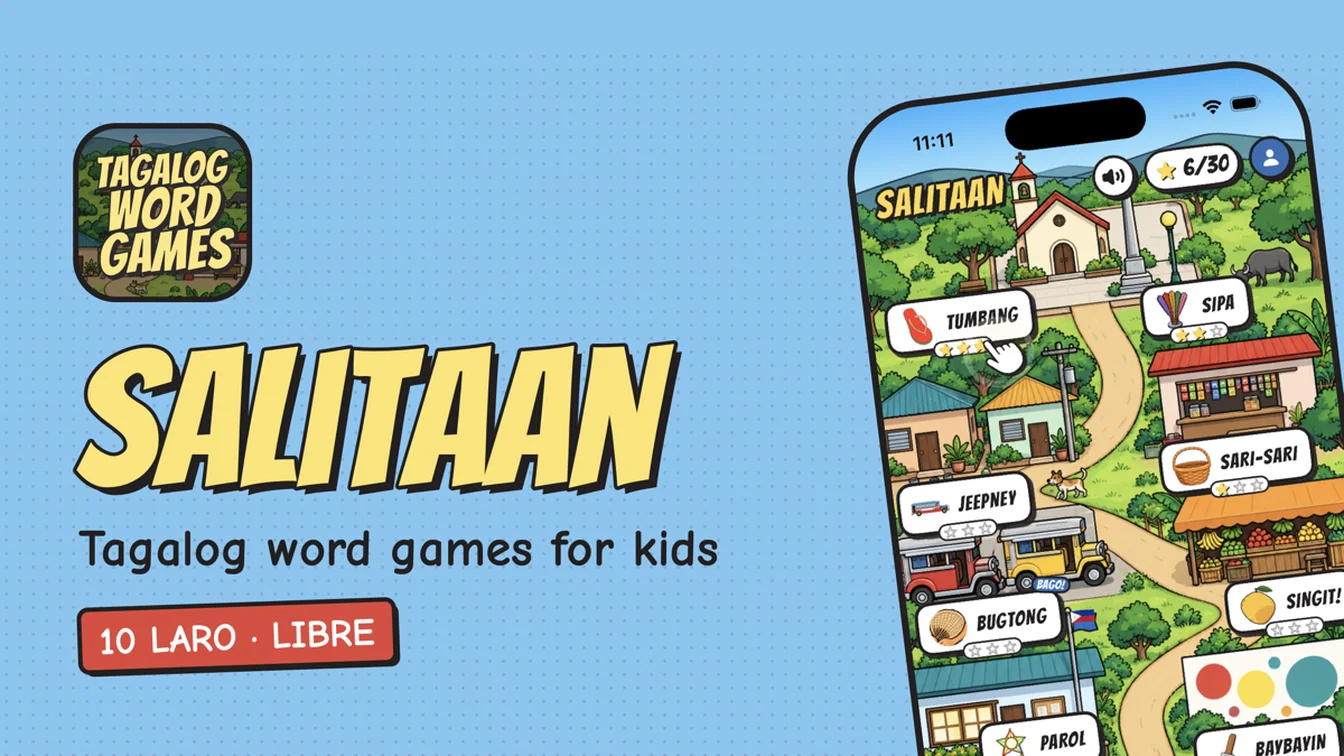
Salitaan: Learn Tagalog the Way Filipino Kids Play
Most Tagalog apps start with a flashcard. Salitaan starts with a slipper.
You're standing on a street in the barangay. A row of tin cans sits on the wall, the window sill, the roof of the sari-sari store. A voice says "itlog." You pull back your tsinelas, let it fly, and knock over the can with the egg on it. Tama!
That's the first of ten games in Salitaan, a Tagalog word app I've been building for the past couple of weeks. It's coming soon to the App Store, and you can play it today in the beta on TestFlight.
Who It's For
Salitaan was made for kids, and it looks the part: every scene is drawn like Filipino komiks, and nothing needs reading to get started. But the words are real words, and the lessons underneath the games are real lessons. So it's also for:
- Heritage learners who grew up hearing Tagalog from Lola but never quite speaking it back
- Adults starting from zero who want something friendlier than a grammar table
- Parents who want to learn alongside their kids, or finally keep up with them
- Anyone with a Filipino partner, a trip home coming up, or a family group chat they'd like to understand
If you already speak Tagalog, it's a warm way to pass the language on.
Every Word, Said Out Loud
You can't learn Tagalog from spelling alone. The same letters can mean different things depending on where the stress falls: báka is a cow, baká means "maybe." A final s or ng that gets swallowed changes the word.
So every word in Salitaan is said out loud, along with every customer's order, every riddle, and every "Tama!" and "Ay, mali!" I went through the pronunciations by ear and fixed the ones that were off, stress marks and all. When you hear a word in the app, that's how it's said.
Ten Games, Ten Lessons
The games live on a map of the barangay: the plaza, the kanto, the sari-sari store, the jeepney terminal, the fruit stand, the garden, Lola's porch.
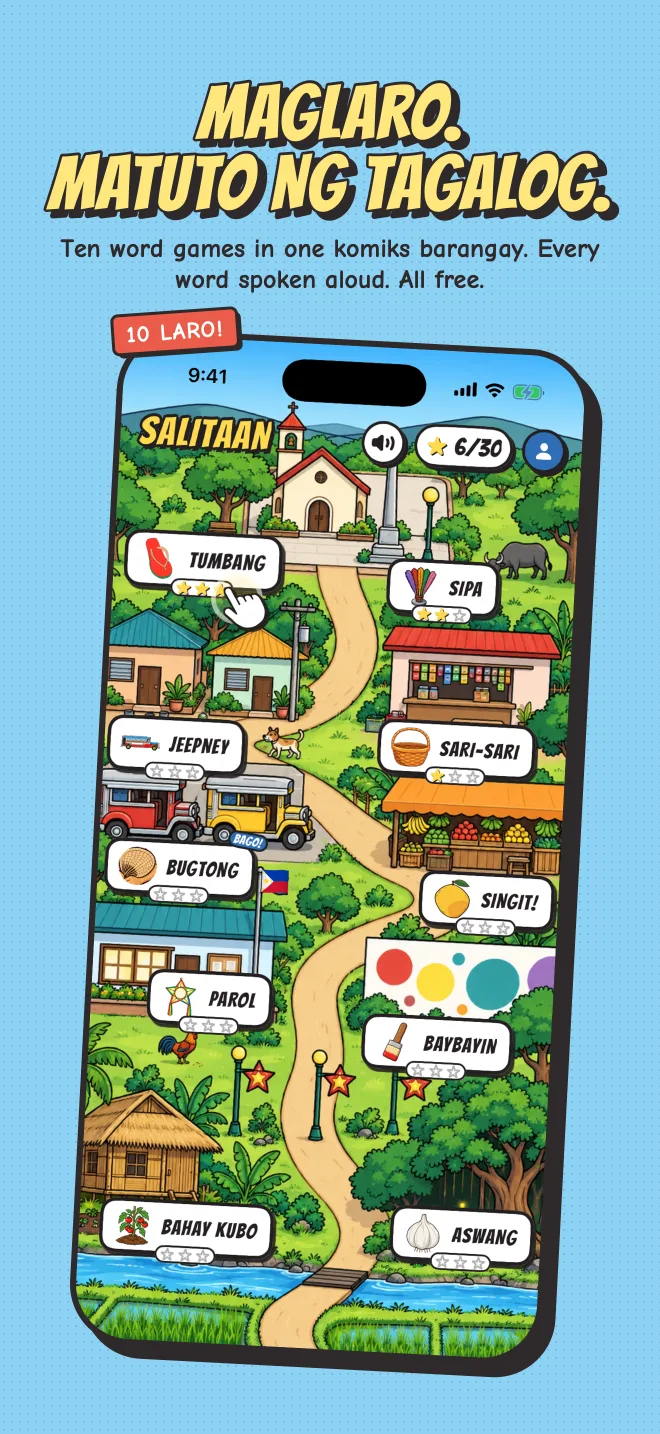
Each one is a game Filipino kids already know, and each one teaches a different part of the language.
Words you can picture
More than 170 everyday words, each with its own drawing: animals, food, things around the house, nature, the body, people, vehicles, feelings, numbers and colors.
- Tumbang Tsinelas — hear the word, hit the can with the right picture
- Aswang Night — hear the word, watch the creatures carry their pictures, then bonk the right one with a bawang before they reach the gate. It's a memory game in a spooky (but cute) costume
- Sari-Sari Store — a customer asks "Pabili po ng isang mansanas at dalawang saging," and you drag one apple and two bananas into the basket. You pick up counting, po, and the little -ng that links a number to its noun, without anyone calling it grammar
Syllables (pantig)
Tagalog is built out of syllables, and once you hear them, long words stop being scary.
- Sipa Syllables — kick the sipa into the syllable bubbles in order: it · log, kid · lat, ba · hag · ha · ri, e · ro · pla · no
A tip you'll notice as you play: two consonants in a row usually split between syllables (it·log), but Spanish-style pairs like pl and tr stay together (e·ro·pla·no).
Affixes (panlapi)
This is where Tagalog gets fun. Tagalog builds verbs by adding pieces to a root word, and sometimes the piece goes right in the middle.
- Singit! — a vendor tosses a fruit with a root word on it. You slice it at the right spot, and a sticker slides in
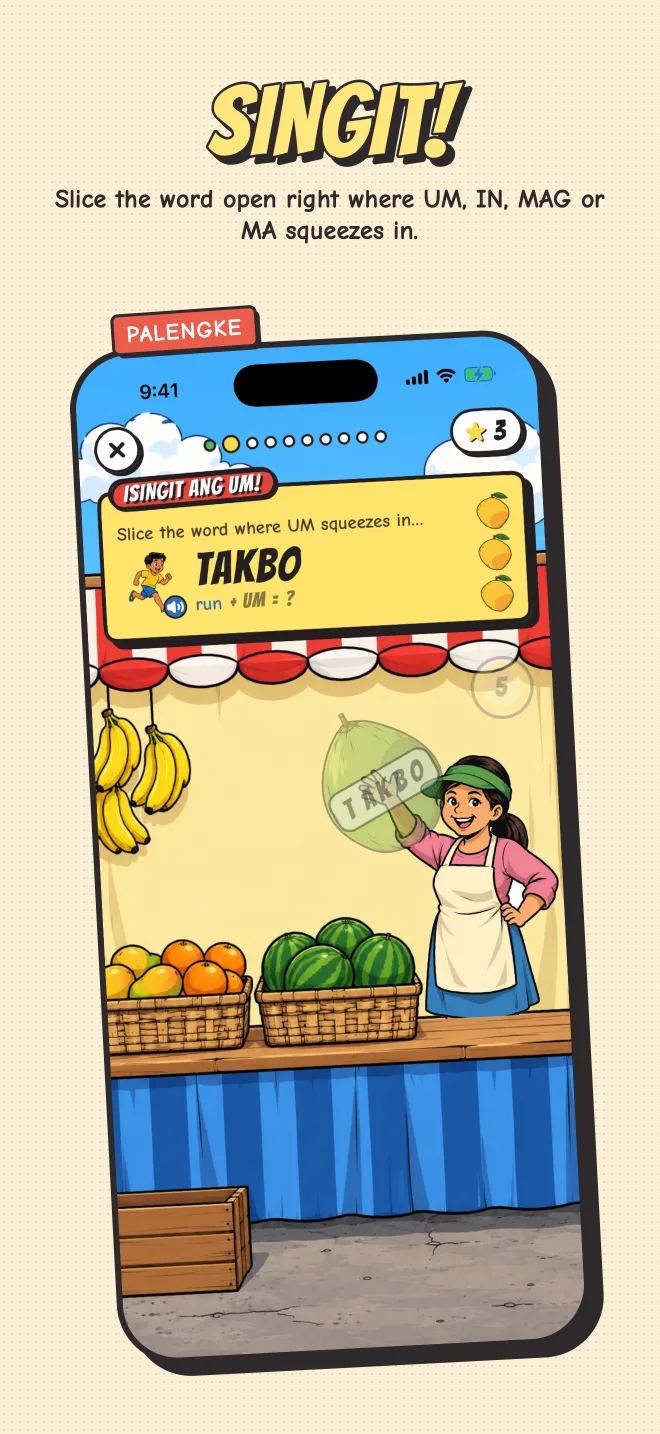
Singit means "to squeeze in," and that's what the infixes do:
- kain (eat) → k-um-ain
- gawa (make) → g-in-awa (made)
- laro (play) → mag-laro
- ganda (beauty) → ma-ganda (beautiful)
After a few rounds you stop memorizing kumain as a word and start seeing kain with -um- inside it. That's the moment Tagalog starts to click.
Past, present, future
Tagalog doesn't really have tenses the way English does. It has aspect: has the action happened, is it happening, or will it happen?
- Jeepney Rush — three jeepneys pull in with signs: KAHAPON (yesterday), NGAYON (now), BUKAS (tomorrow). You hear a verb and ride the right one
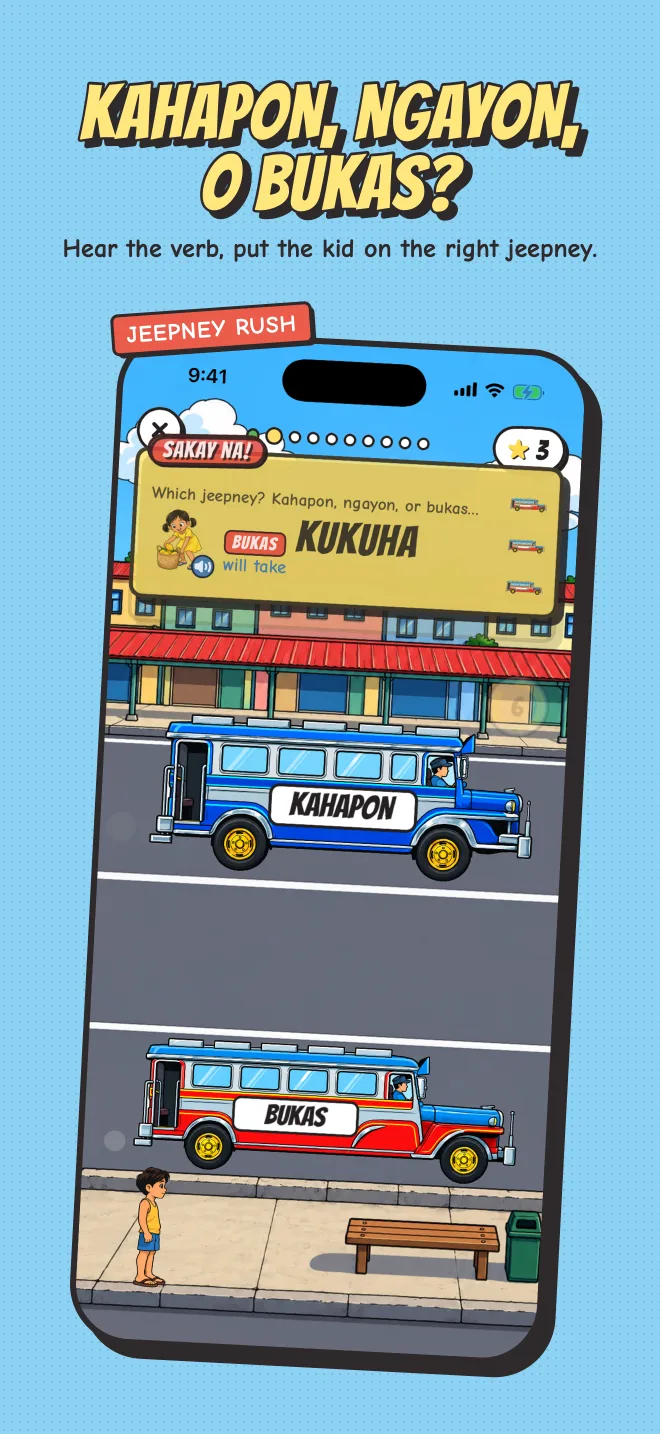
The pattern is one of the most useful things a beginner can learn:
- kumain — ate (kahapon)
- kumakain — is eating (ngayon)
- kakain — will eat (bukas)
Notice the doubled first syllable, ka-: that's the sign the action isn't finished. The same thing happens with uminom, umiinom, iinom (drink). The game starts easy, with the time word said aloud and the lanes in order, and gets harder until you're going on the verb alone.
Spelling
- Parol — hear a word and drag through the letters on a Christmas lantern to spell it. Each word lights one ray of the parol
Riddles (bugtong)
- Bugtong of the Day — Lola sits on her rocking chair and reads you a traditional riddle, and you pick the answer from three pictures. There's a new one every day
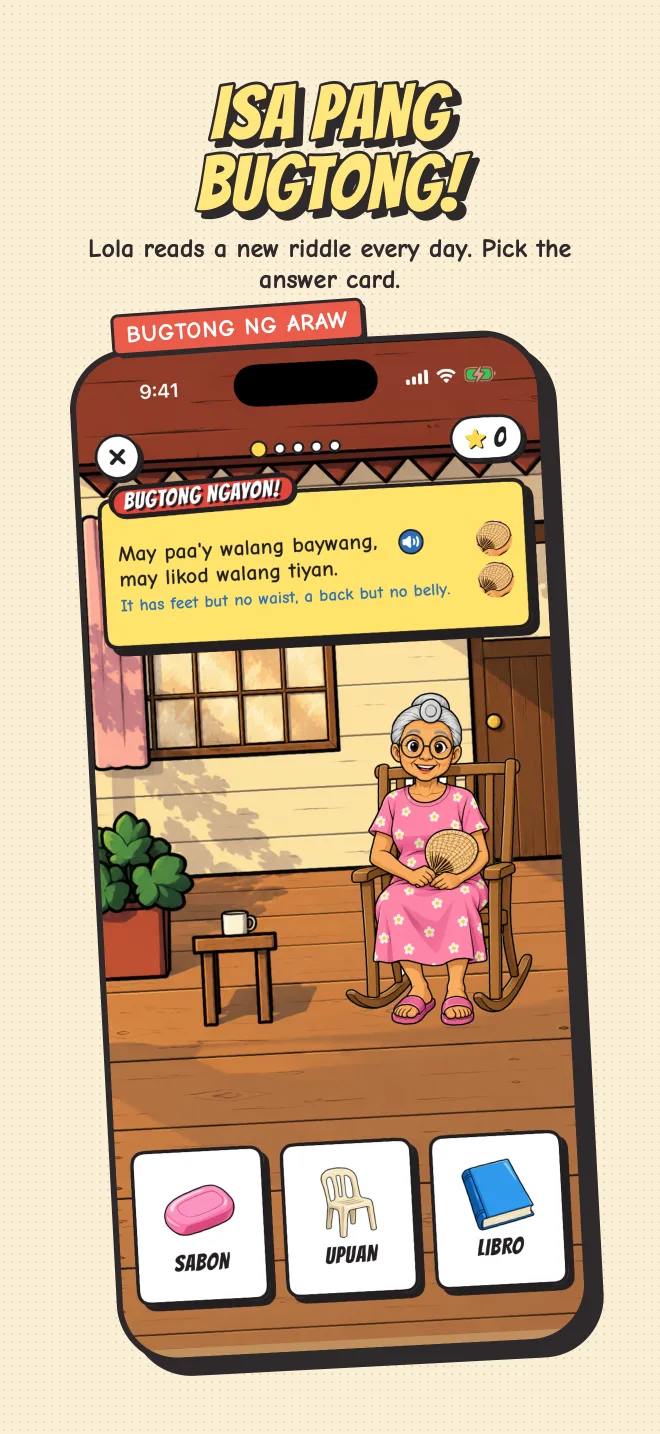
Bugtong are some of the oldest Tagalog you can learn, full of the imagery and rhythm of the language. Try this one:
"Isang balong malalim, punong-puno ng patalim." (A deep well, full of blades.)
The answer is at the bottom of this post.
Baybayin
This one is my favorite.
- Baybayin Brush — hear a word, then paint it on a mural wall in Baybayin, the script Tagalog was written in before the Latin alphabet
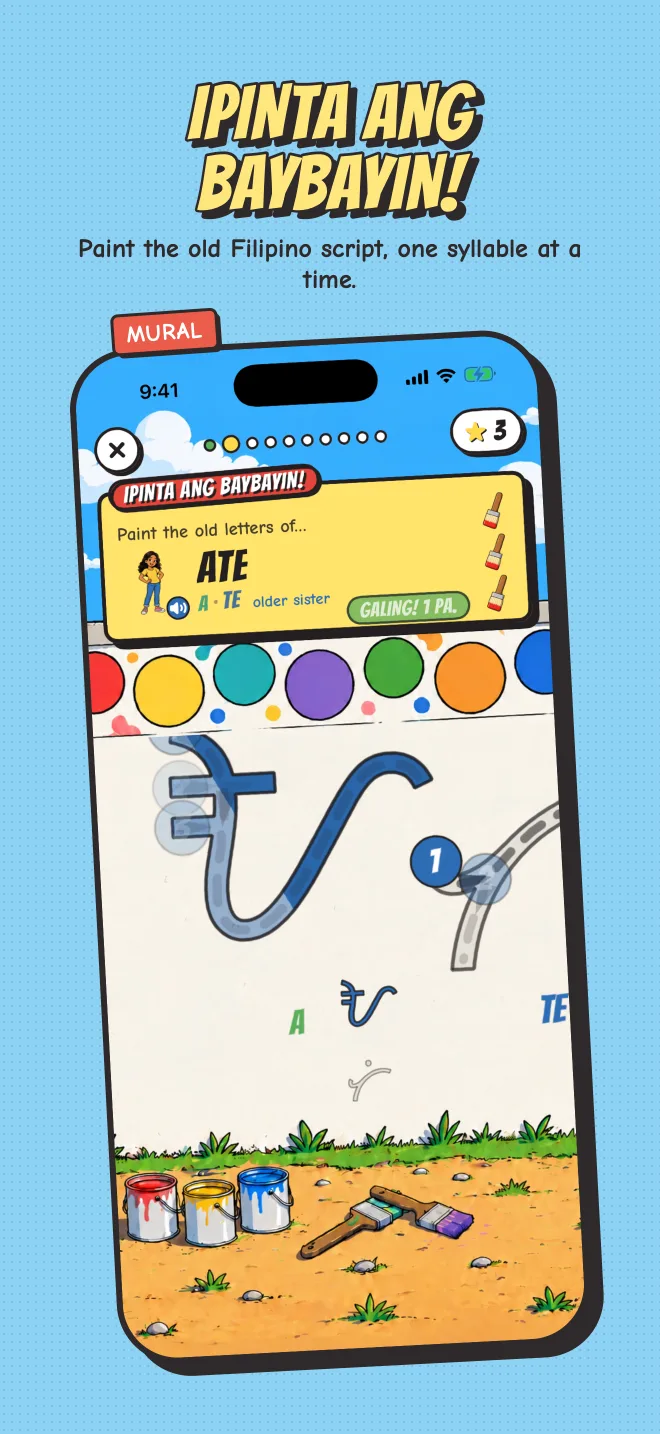
Each Baybayin character is a whole syllable, so the word bata is just two characters: ba and ta. Numbered guides show you each brush stroke in order, and a ghost brush shows you how first. You don't have to be precise; you just have to paint. It's a lovely way to see that the syllables you've been kicking and slicing in the other games were the building blocks of the writing, too.
And a song
- Bahay Kubo Garden — plant the folk song line by line. Singkamas at talong, sigarilyas at mani... Each vegetable you plant grows on its mound while the melody plays
If you've ever sung Bahay Kubo without knowing what half the vegetables were, now you'll know.
Tips for Grown-Up Learners
- Pick your language. The menus and instructions can be in Tagalog or English (switch it in the profile). Start in English, then flip to Tagalog when you're ready for full immersion. The words you're learning always stay Tagalog
- Say it back. When the app says a word, say it out loud too. Your mouth needs practice as much as your ears do
- Visit your collection. Every word you learn goes into your SALITAAN list. Tap any of them to hear it again
- Play with a kid. Kids are ruthless and fast. You'll learn more losing to a seven-year-old than winning alone
- Come back for Lola. A daily 5 PM reminder brings a new bugtong, which makes a nice one-minute habit
For Parents
Every game is free. There's no account and no sign-up, and progress stays on the device. The app shows an ad only between rounds, never during play, and the ads are set up for kids: child-directed, never personalized, no tracking. A one-time purchase, Buong Barangay, removes the ads for good, behind a parental gate.
Join the Beta
Salitaan is coming soon to the App Store. Until then, you can play it on TestFlight today.
- Install TestFlight from the App Store if you don't have it
- Open the invite: testflight.apple.com/join/Ua37rx5H
- Tap any place on the barangay map and play
It runs on iPhone and iPad.
What I'd love to hear from testers, especially native speakers: any word that sounds wrong, any moment that confused you or your kids, and how the ads feel. Send notes through TestFlight's feedback button or to apps@kantoprojects.com.
Learn more at salitaan.kantoprojects.com.
The answer to the bugtong: bibig, the mouth. The well is your mouth, and the blades are your teeth.